

When customers start messaging in different languages, your first decision is not which translation tool to buy. It is which questions you can answer reliably, which need verified information, and when a person should take over. Build your Instagram and WhatsApp support around those boundaries.
In short
- Start with your two highest-priority languages and five common customer questions.
- Create one approved source for product details, delivery policies, returns, and appointments.
- Connect Instagram and WhatsApp, then test each language on both channels.
- Prepare responses for unclear language, missing information, and complaints.
- Launch with a narrow scope and review accuracy, repeated questions, and requests needing human help.
Set up a multilingual chatbot in 8 practical steps
A multilingual chatbot aims to understand customer questions and respond in an appropriate language. Good support goes beyond fluent translation: an English-speaking customer should receive the same return conditions as a Turkish-speaking customer.
The language rules and conversations below are implementation recommendations, not a list of guaranteed product capabilities. Confirm Data2AIBot’s supported languages, language-detection behavior, and available human-support workflows using your own scenarios before launch.
1. Choose two languages and five customer intents
Review recent Instagram DMs and WhatsApp conversations. Remove personal information, then group messages by language, topic, and outcome. Start with the languages that combine meaningful message volume with business importance rather than trying to cover every market immediately.
Five useful starting intents are product questions, delivery coverage, returns, appointment requests, and help with an existing order. Define the answer boundary for each one.
For example, explaining which countries you ship to can rely on approved documentation. Reporting the location of a particular parcel requires current order information. Do not treat those as the same support task.
| Approach | When to consider it | Main check |
|---|---|---|
| Ask customers to choose a language | Short or ambiguous opening messages are common | Does the extra step create unnecessary friction? |
| Follow the opening message’s language | Customers usually write complete questions | What happens when languages are mixed? |
| Use human-led support | Complaints, exceptions, or sensitive requests arise | Can the team actually support that language? |
These are workflow choices, not a product feature matrix. Validate whether and how your chosen tool supports them. Also check who will handle exceptions: adding a language without a workable follow-up process can leave customers stranded.
2. Organize the knowledge base before translating
A disorganized source does not improve when translated. It simply creates inconsistent answers in more languages. Resolve policy conflicts first, then prepare customer-facing versions.
Give each knowledge entry five elements:
- Topic: International delivery, for example.
- Approved answer: The destinations you currently serve.
- Boundary: Conditions affecting cost or timing.
- Owner and review date: Who confirms that the information remains valid.
- Language notes: Product names or terms that should not change.
Data2AIBot supports training through uploaded files and imports from Google Docs and Google Sheets. Ecommerce catalogs can use spreadsheet column mapping. These are knowledge inputs; do not assume they provide live inventory or order tracking.
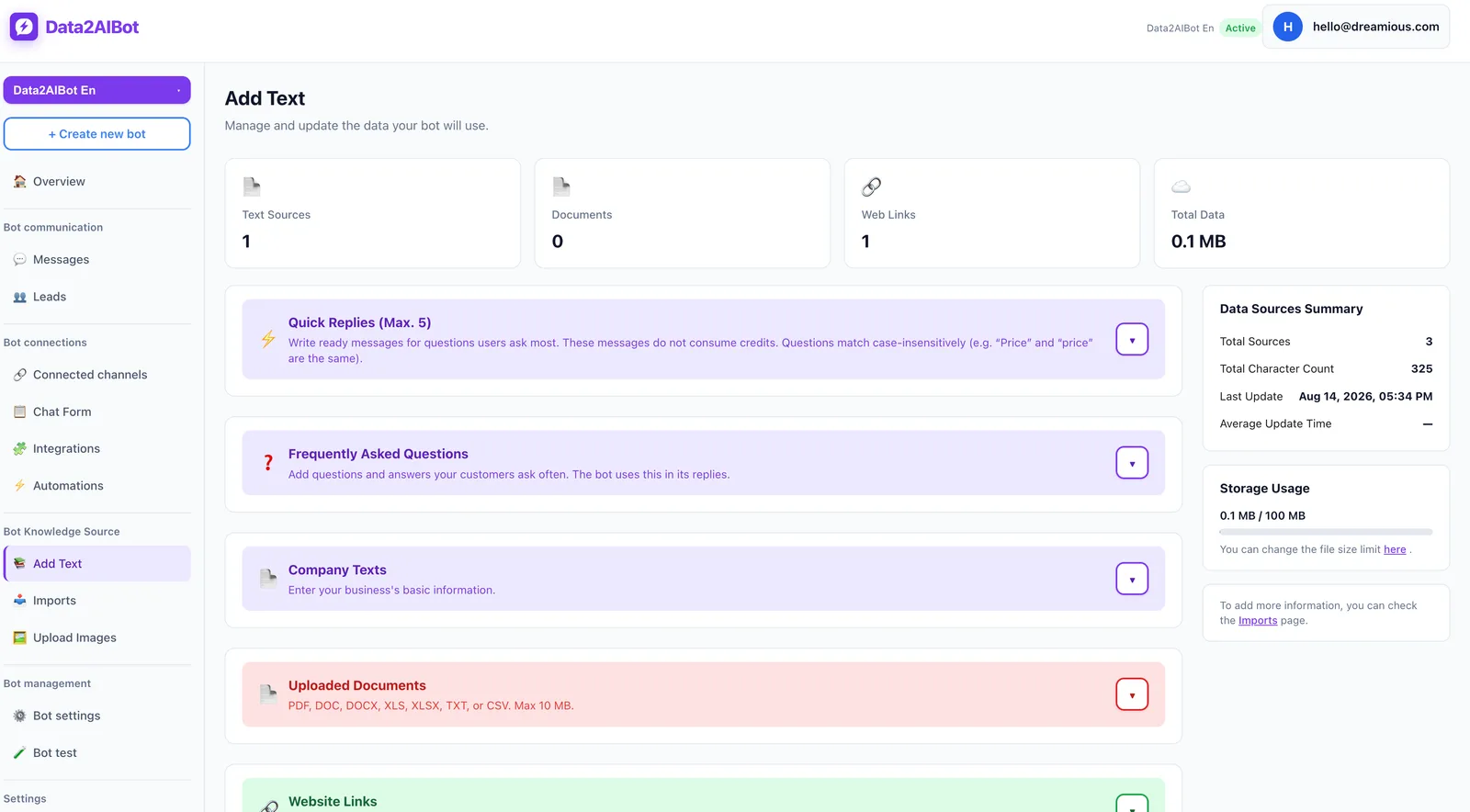
Remove outdated policies rather than leaving conflicting versions in place. An internal note saying one document takes priority does not establish that the software automatically applies source-priority rules.
Create a small terminology sheet, too. “Exchange” and “refund” are different outcomes. So are “appointment request” and “confirmed booking.” Check that translations preserve those distinctions, along with product codes, dimensions, currencies, and exclusions.
3. Connect Instagram and WhatsApp
Data2AIBot offers a no-code setup for connecting Instagram and WhatsApp in a few steps and launching in minutes. It is Meta’s official Technology Provider. One bot can handle both channels through a unified inbox approach.
Review the Instagram AI chatbot and WhatsApp AI chatbot channel pages before connecting. Use the correct business accounts and number, and complete the permissions and eligibility steps presented during setup.
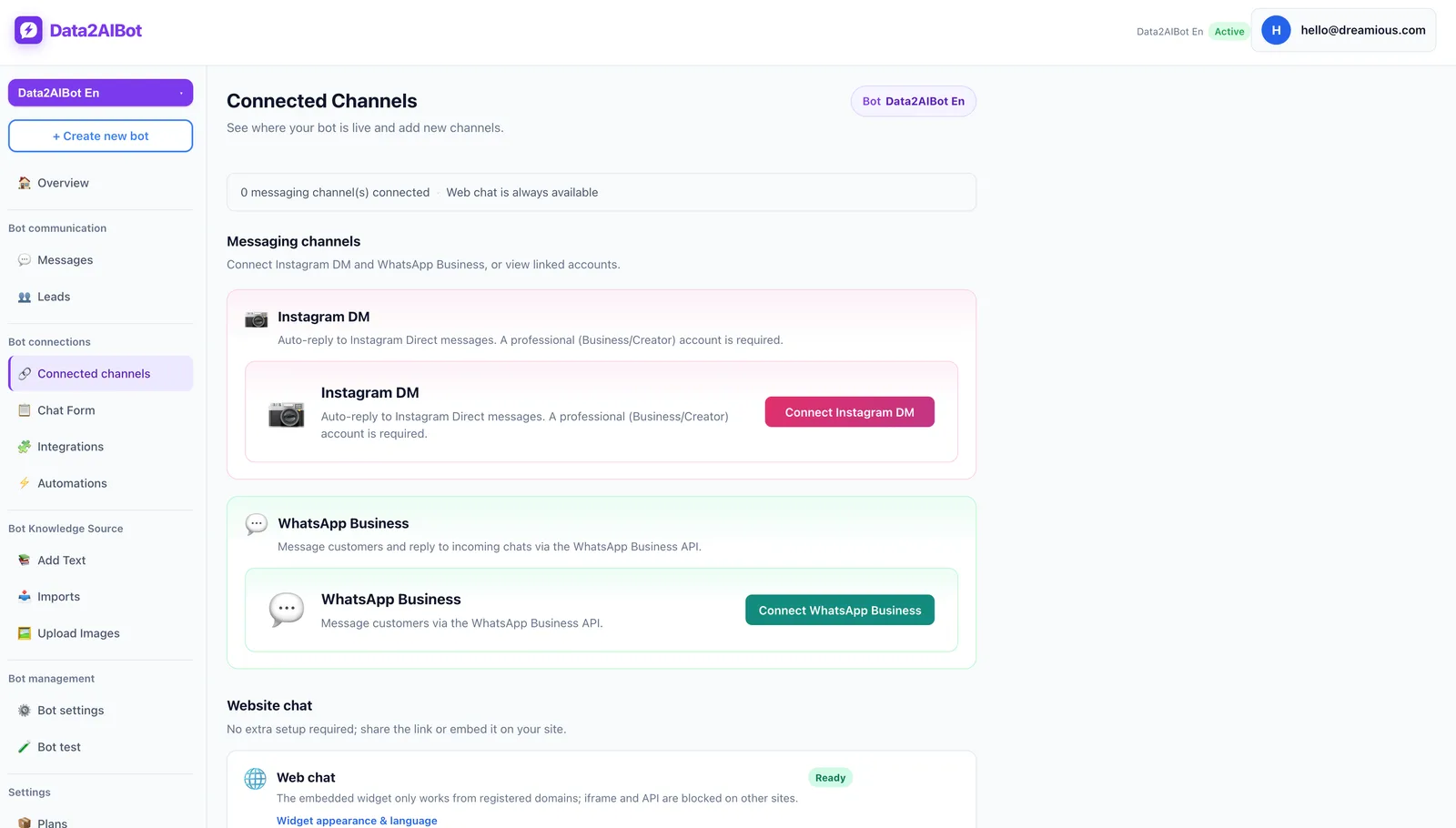
A successful connection is not the same as a tested support experience. Send an independent test message through each channel. Check that the message arrives, the reply reaches the right conversation, and the language behavior matches your expectations.
Ask the same policy question on both channels, such as “Do you deliver to Germany?” The wording can differ, but the underlying policy should not. Do not assume that a person’s Instagram and WhatsApp identities are automatically matched just because the channels share a bot.
4. Write rules for language and uncertainty
Create a one-page response standard for your team. Configure the behaviors your tool supports and address the remaining requirements through your operational process.
A practical standard might say:
- Respect an explicit language preference.
- Ask a brief clarification when the opening message does not reveal a language.
- Do not treat a delivery country as the customer’s preferred language.
- Never invent prices, availability, delivery dates, or exceptions missing from approved sources.
- Preserve conditions, exclusions, and negative statements when translating.
For example, “Customers pay return shipping for international returns” should not become simply “We accept returns.” Shortening the answer must not change who pays.
Make uncertainty useful rather than vague: “The available information does not confirm delivery to that country. The team needs to check it.” Avoid promising a response deadline unless your team can meet it.
Also test language changes within a conversation. A customer may open in Turkish and continue in English. Check whether the response follows the new preference, and establish what your team will do if it does not.
5. Test realistic conversations in different languages
The exchanges below are sample test cases. Their policies are illustrative, not real business terms or claims that a particular automation is already configured. Replace them with your own approved information.
English: Delivery coverage versus a promised arrival date
Customer: “Do you ship internationally?”
Sample response: “Which country would you like delivery to? I can check the delivery information available for that destination.”
Customer: “Germany. Can it arrive by Friday?”
Sample response: “The example policy includes Germany, but it does not confirm arrival by Friday. That date needs to be checked by the team.”
This tests two separate facts: whether the destination is supported and whether a deadline can be promised. A general “yes” must not accidentally confirm both. If delivery estimates vary by product, make that dependency explicit in your real policy.
German: A used product and a return request
Customer: “Kann ich einen benutzten Artikel zurückgeben?”
Sample response: “Laut der Beispielrichtlinie gilt die reguläre Rückgabe für unbenutzte Artikel. Ist der Artikel beschädigt oder möchten Sie ihn aus einem anderen Grund zurückgeben?”
The customer asks whether a used item can be returned. The response explains the example’s standard unused-item policy while checking whether damage is involved. That distinction matters: a store policy should not be presented as a definitive statement about the customer’s legal rights. Have the team review exceptions.
Arabic: An appointment request is not a booking confirmation
Customer: “هل يمكنني حجز موعد غدًا؟”
Sample response: “ما الوقت الذي تفضله غدًا، وفي أي مدينة؟ هذا طلب موعد، وليس تأكيدًا للحجز.”
The customer wants an appointment tomorrow. The response asks for a preferred time and city and explicitly says this is a request, not a confirmed booking. Before confirming anything, restate the calendar date and time zone clearly.
Data2AIBot can collect appointments and reservations in chat and offers Calendly automations. Do not assume that collecting a request always includes live availability verification or a completed booking.
Mixed Turkish and English: Product ambiguity comes first
Customer: “Merhaba, do you have this in size M?”
Sample response: “Hello! Which product do you mean? Would you prefer English or Turkish?”
Resolve the product reference before answering. A catalog listing a medium size does not prove that medium is currently in stock. If your source only describes available product options, keep the response within that limit.
English: An upset customer asks for live order status
Customer: “My order still hasn’t arrived. Where is it?”
Sample response: “I’m sorry it hasn’t arrived. I can’t verify live order status from the available information. Please use the business’s approved support process so the team can check it.”
This response avoids fabricating tracking information. Replace the generic support reference with your actual approved process. Do not ask customers to send passwords, payment-card details, or unnecessary identity documents in an open conversation.
6. Connect visitor and lead follow-up to your support process
A new sales inquiry and an existing customer’s complaint need different follow-up. Define a team recordkeeping standard covering preferred language, issue, unanswered question, and next action. Treat these as operational requirements rather than assuming they are built-in product fields.
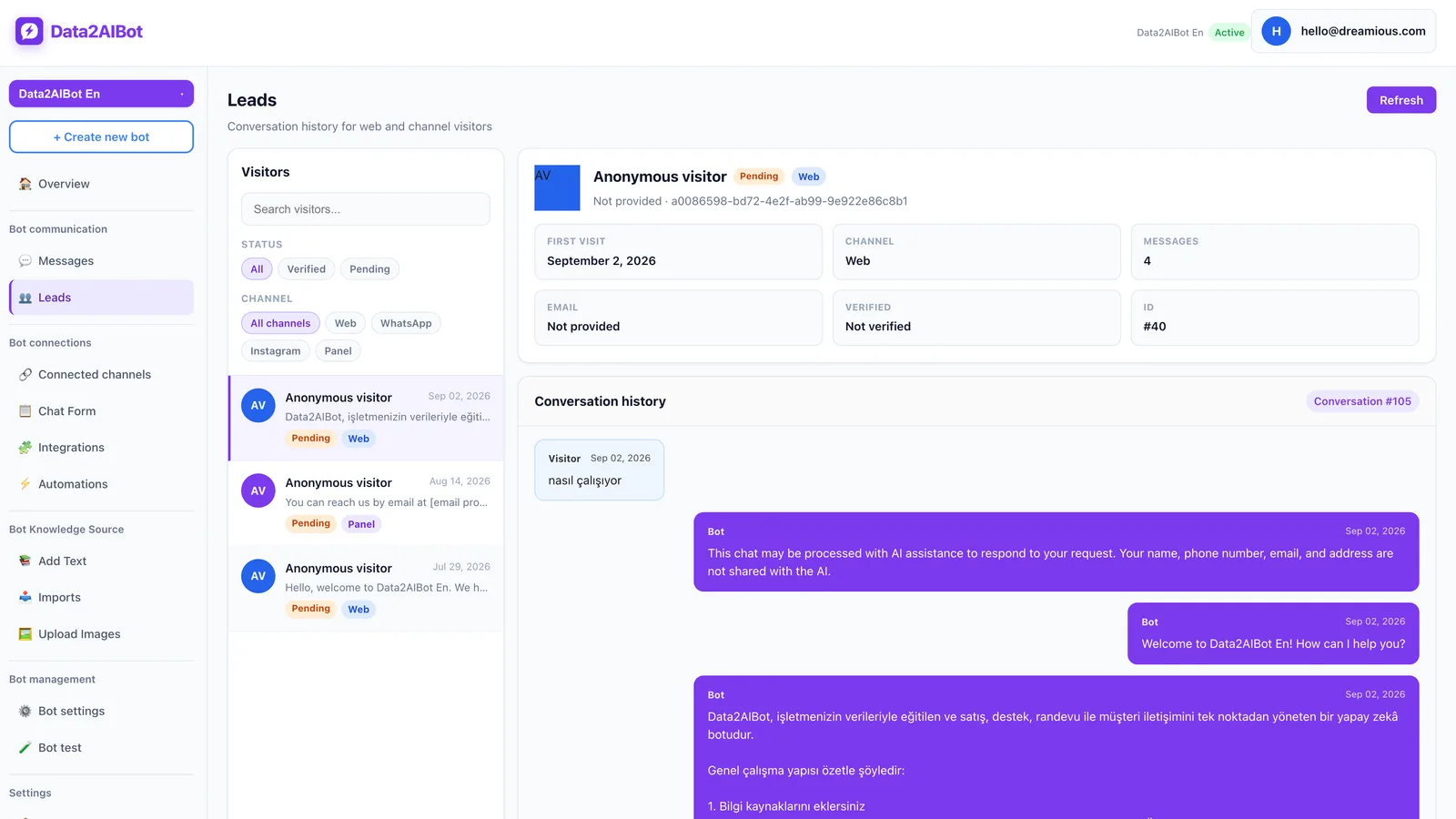
Data2AIBot’s Bitrix24 integration can create or update leads and contacts from Instagram, WhatsApp, and website chats, and write conversation history to the CRM timeline. That history gives the next person context instead of forcing the customer to start over.
However, creating a CRM record does not establish automatic assignment to a language-qualified agent. Define ownership and follow-up separately. Do not promise an automatic transfer unless you have verified the actual workflow.
Collect contact information only when it serves the request, and explain why you need it. Someone asking about shipping destinations should not have to provide a phone number before receiving a general policy answer.
7. Run a pre-launch test matrix
A manageable starting test uses two languages, five intents, and two channels: 20 core scenarios. Add a typo, missing detail, or follow-up variation to each for a 40-conversation review set. This is a suggested testing scope, not a product quota.
Score each conversation on four questions:
- Accuracy: Does the answer match the approved source?
- Language: Does it use the expected language and appropriate tone?
- Boundaries: Does it make unsupported assumptions?
- Next step: Does the customer know what to do?
Read beyond the first reply. Ask follow-ups such as “What if the item was discounted?” or “Can I change the appointment date?” Check whether the answer remains consistent while handling the new condition.
Do not mark a scenario ready when it contains a critical policy error. Correct the source or configuration, repeat the test, and try alternative wording. Have a fluent reviewer check returns, fees, and dates rather than relying only on how polished the response looks.
8. Launch narrowly and measure outcomes
Begin with verifiable topics such as product information and general policies. Use your actual team process for transactions and exceptions. Review a small conversation sample daily, grouping problems by language and intent.
Track four straightforward signals: conversations with correct information, repeated questions, requests needing human review, and replies delivered in the preferred language. Customer silence is not reliable proof of resolution.
Data2AIBot offers a 14-day free trial with no credit card required, and you can cancel anytime. Start Data2AIBot for free to test your own questions, or arrange a demo to confirm your language requirements before expanding the rollout.
Multilingual chatbot FAQ
Do I need a separate chatbot for every language?
That depends on the tool’s language capabilities and configuration. Data2AIBot can use one bot for Instagram and WhatsApp together. That channel capability does not by itself confirm support for every language; validate each target language independently.
Can an Instagram chatbot detect a customer’s language automatically?
Automatic language detection is an approach to evaluate, not a capability to assume. Confirm the behavior in your chosen tool. Short messages such as “Hi,” emojis, or product codes may not identify a language clearly, so prepare a clarification option.
Do I need to translate my whole knowledge base for WhatsApp support?
Start with critical policies and frequent questions rather than translating every document immediately. Do not assume untranslated sources will produce accurate answers in every language. Have a fluent reviewer check customer-facing fees, deadlines, return conditions, and exceptions.
Can a multilingual chatbot track an order?
A reliable order-status answer requires access to current order information. Static documents and catalog imports are not enough. The Data2AIBot capabilities described here do not establish a live order-tracking feature, so keep that boundary clear in testing and customer replies.
What should happen when a customer switches languages?
Aim to follow an explicit new preference. If the preference is unclear, ask a short confirmation question. Test this behavior on both Instagram and WhatsApp using multi-message conversations, not just isolated greetings in different languages.
How should I assess multilingual chatbot costs?
Include content preparation, language review, and human follow-up as well as software charges. Confirm current commercial terms with the provider rather than estimating from another business’s setup. Data2AIBot’s verified starting offer is a 14-day free trial without a credit card.
When is multilingual support ready to launch?
Start a limited rollout when critical policies are accurate on both channels, uncertain questions do not produce invented facts, and the team can handle exceptions. Consistent answers in two well-tested languages are a stronger foundation than broad coverage you cannot verify.
Get started with Data2AIBot
You can sign up for Data2AIBot completely free — no credit card required — and connect Instagram and WhatsApp in minutes.