

Yes—an ecommerce chatbot can help increase sales by answering buying questions and helping customers take the next step, but installing one does not prove that sales increased. Its value depends on accurate answers, useful guidance, and a clear route to human help. Judge it by completed purchases and support outcomes, not the number of conversations it starts.
TL;DR
- An ecommerce chatbot supports sales when it resolves buying questions; more conversations alone do not prove revenue growth.
- Use WhatsApp, Instagram, or website automation where customers already ask repetitive questions.
- Compare completed purchases, unresolved questions, and staff workload before expanding automation.
- Keep human help available for exceptions, complaints, and questions the chatbot cannot answer accurately.
Does an e-commerce chatbot really increase sales?
A chatbot earns its place when it removes a buying obstacle without creating a new one. Answering a product question is useful; confidently giving the wrong answer is not.
Data2AIBot is best for small businesses seeking no-code customer messaging across WhatsApp, Instagram, and websites. The Data2AIBot platform supports that messaging use case, but you still need to check answers and measure business results.
Choose the approach that matches the question, rather than treating every conversation as an automation opportunity.
| Approach | Best for | Sales-support benefit | Limitation |
|---|---|---|---|
| Chatbot-led answers | Repeated questions with clear, approved answers | Gives shoppers guidance without waiting for a manual reply | Incorrect or outdated information can mislead shoppers |
| Human-led support | Complaints, unusual requests, and judgment calls | Lets someone assess context and exceptions | Depends on staff being available |
| Chatbot with human support | A mixture of routine and complex questions | Separates repeatable answers from questions needing attention | Requires clear ownership of unresolved conversations |
For your 2026 evaluation, keep the distinction simple: answering messages is an activity; helping customers complete suitable purchases is the intended outcome.
Why this matters
A customer asking about a product is telling you what they need to decide. If your answer does not address that need, a fast response is still an unhelpful response.
Start with conversations that reveal uncertainty. A shopper asking whether an item suits a particular use needs relevant product information, not a generic welcome message or an immediate push toward checkout.
Automation also creates responsibilities. Someone must maintain the information, review mistakes, and take over questions outside the approved scope. Treat an ecommerce chatbot as a maintained customer-service process, not a finished installation.
Where can an ecommerce chatbot support a sale?
Look for repeatable questions that stand between product interest and a decision. These are practical starting points, not promises that every automated answer produces an order.
Product guidance: best for factual buying questions
A chatbot can explain product information supplied by your business. Suitable questions concern materials, intended uses, care instructions, or differences that your product descriptions already explain.
The benefit is relevance: you help shoppers find the detail they need without making them search through unrelated information. The limitation is the source material; incomplete descriptions leave gaps that automation should not fill with guesses.
For example, if a shopper asks whether an item suits outdoor use, the answer should follow the approved product information. If that information says nothing about outdoor use, ask a person to confirm rather than inventing reassurance.
Purchase guidance: best for explaining the next step
A chatbot can explain a documented purchasing process, such as where to select a product option or how to find your published delivery information. Keep the response tied to the shopper's actual question.
The benefit is a clear next action. The limitation is that explaining a process does not mean the chatbot can perform it, modify an order, or access a customer's account.
Do not imply those capabilities unless your actual setup supports them. A helpful explanation and a completed transaction are different outcomes.
After-hours answers: best for routine questions
Automated replies can address approved questions when staff are not answering messages. Separate questions that can be resolved immediately from those that require a person.
The benefit is continuity for routine conversations. The limitation is expectation management: an instant acknowledgment is not the same as a resolved issue.
If human help is needed, explain the next step without promising a response time your team cannot meet. Review those unresolved conversations when staff return.
Why ecommerce chatbot results vary
Your results depend on the questions, the information, and the operating process—not just the presence of a chat window. Use these factors to decide what to automate first:
- Answer quality. Approved, current information gives the chatbot a sound basis for replies. Conflicting policies make reliable answers harder.
- Question fit. Routine factual questions suit automation better than requests requiring discretion, negotiation, or an exception.
- Channel fit. Start where customers already ask questions. Adding automation to an unused channel does not address your existing workload.
- Human support. Give unresolved conversations an owner. Do not leave customers repeating the same request to an automated reply.
- Measurement quality. Define a completed purchase and distinguish it from a product view, checkout visit, or conversation.
- Ongoing maintenance. Update answers when your products or policies change. Review failures as well as successful exchanges.
For a 2026 rollout, prioritize the factor you can fix directly. If shoppers keep asking a question your product page does not answer, improve the underlying information before automating its distribution.
How do you test whether a chatbot helps sales?
Use a narrow test with a written scope. The following durations and quantities are a suggested working plan, not industry benchmarks or promised results.
1. Pick one channel
Start with 1 channel where your team already handles customer questions. This keeps the review manageable and makes it easier to identify where conversations break down.
Choose a website, WhatsApp, or Instagram based on your own message history. Do not launch everywhere simply because a platform supports several channels.
2. Prepare approved answers
Choose 10 recurring questions as an initial working set. For each question, write the approved answer, identify its source, and specify when someone should take over.
Your list can include product facts, policy explanations, and purchase guidance. Exclude sensitive requests or account-specific actions unless your process explicitly supports them.
3. Define the outcome
Decide what counts as success before the test starts. A completed purchase, a correctly resolved question, and reduced manual work are separate outcomes; record them separately.
For your 2026 test, also define what counts as a failure. Examples include an incorrect answer, an unanswered request for help, or a conversation that repeatedly loops without progress.
4. Review conversations
Use 14 days as an initial review window, extending it if your message volume is too low to assess the questions you selected. Inspect the actual exchanges rather than relying only on a summary dashboard.
Check whether the reply answered the question, whether the shopper needed further help, and whether staff had to correct it. Record the reason when a conversation fails.
5. Expand carefully
Expand only after the initial answers work reliably in real conversations. Add another question group or channel, then repeat the review.
Keep the changes identifiable. If you change product pages, promotions, advertising, and chat behavior together, you cannot cleanly assign the resulting sales change to the chatbot.
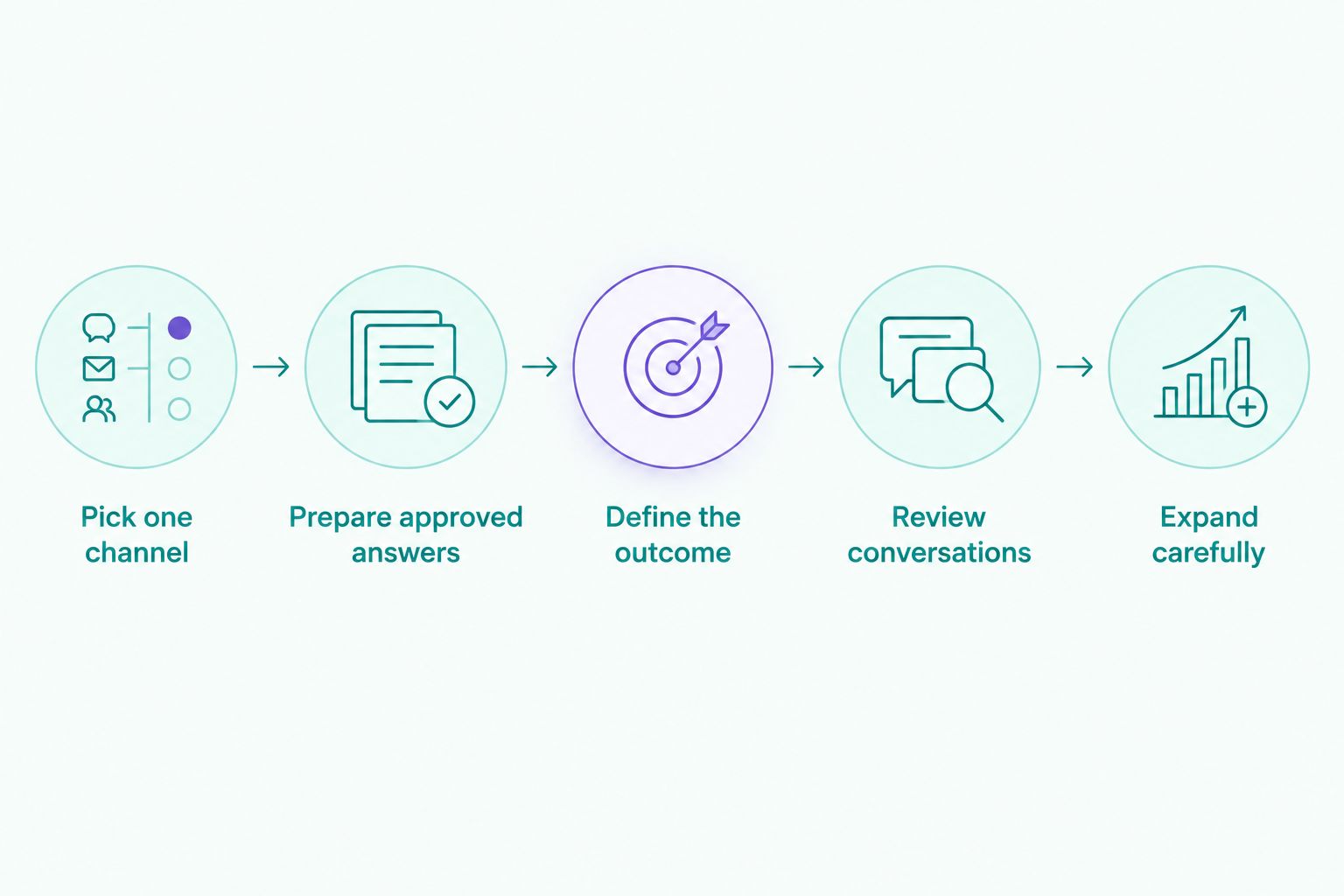
Start with a narrow scope, review real conversations, and expand after correcting problems.
What should you measure besides sales?
Measure usefulness before celebrating activity. A chatbot that starts many conversations but leaves customers confused is not meeting the purpose of customer support.
| Measure | What it tells you | What it does not prove |
|---|---|---|
| Completed purchases after chat | Whether recorded conversations precede orders | That the chatbot caused those orders |
| Correctly resolved questions | Whether customers receive useful answers | That every resolved question creates a sale |
| Unresolved conversations | Where customers still need help | Whether the problem is information, setup, or staffing |
| Staff time spent on repeat questions | Whether repetitive manual work changes | That total operating costs automatically fall |
| Corrections and complaints | Where automated replies create problems | How customers who never complain felt |
Keep your 2026 reporting definitions consistent. Comparing one period's completed orders with another period's checkout visits creates a misleading result, even if both appear under a conversion label.
Where practical, compare similar customer groups with and without chatbot access. If you cannot make a fair comparison, describe the result as an association rather than proof of additional sales.
What should you check before choosing a platform?
Select a platform around the work you need it to do. A feature list is not a substitute for testing your own questions.
Data2AIBot provides no-code chatbot connections for WhatsApp, Instagram, and websites. Its fit is small-business customer messaging; that does not establish that every store system, account action, or specialist workflow is supported.
Ask these questions before committing:
- Can you supply and update the information customers need?
- What happens when the chatbot cannot answer?
- How will staff identify unresolved conversations?
- What customer information is collected, and who can access it?
- Which channel, account, or regional requirements apply to your setup?
- Which charges belong to the platform, and which come from third parties?
Data2AIBot is an official Meta Technology Provider; that status is not a Meta endorsement or a guarantee of sales results. Its stated pricing policy is no hidden or additional platform fees beyond those explicitly stated in the selected plan; check applicable third-party charges separately.
For customer-data privacy, review the current terms and request only information needed for the conversation. Avoid collecting sensitive information merely because a chat field makes it easy to ask.
Can a chatbot replace your customer support team?
Keep human support available for decisions that need judgment. Complaints, disputed information, and unusual circumstances should not get trapped in repeated automated replies.
Automation is useful for repeatable explanations. Your team remains responsible for exceptions, corrections, and maintaining the information customers receive.
Start by identifying repetitive customer questions you can automate. Then draw a clear boundary around questions that require a person.
Does faster replying automatically mean more sales?
Faster replying alone does not establish a sales increase. The reply must address a real buying question, and the customer must still decide that the product suits their needs.
A quick but inaccurate answer can create extra work. Review correctness and completed outcomes alongside response speed.
Is a small FAQ enough to start?
A small FAQ is a practical starting point when it covers genuine recurring questions. Keep the scope narrow and provide a route to human help for anything outside it.
You do not need to automate every conversation before testing usefulness. Begin with the questions you can answer accurately and maintain consistently.
FAQ
Does an ecommerce chatbot guarantee more sales?
An ecommerce chatbot does not guarantee more sales. It can support buying decisions, but you need to measure completed purchases and distinguish correlation from a demonstrated increase.
What's the best first task for an ecommerce chatbot?
The best first task is a recurring factual question with an approved answer. Start with questions customers already ask, rather than creating an elaborate conversation nobody needs.
Can I use a chatbot for Instagram and WhatsApp customers?
Data2AIBot supports no-code customer messaging connections for Instagram, WhatsApp, and websites. Check the account, channel, and regional requirements that apply to your business before connecting a channel.
Do I need coding skills to start?
A no-code chatbot platform does not require you to write code for its no-code setup. You still need accurate business information, testing, and someone responsible for unresolved questions.
How long should I test an ecommerce chatbot?
Use 14 days as an initial review window, not a universal benchmark. Extend the review if you have too few relevant conversations to assess answer quality and customer outcomes.
Should a chatbot handle complaints without a person?
Give complaints a clear route to human support. A chatbot can explain a published process, but exceptions and disputed circumstances require judgment.
What should I track in a 2026 chatbot review?
Track completed purchases, correctly resolved questions, unresolved conversations, staff workload, and corrections in your 2026 review. Keep those measures separate so conversation volume does not get mistaken for revenue.
One last thing
An unresolved question is also an editing task. If customers repeatedly ask for the same missing detail, add it to the relevant product information as well as the chatbot's approved answers.
That gives you a useful next move even before you establish a sales effect: make the answer easier to find wherever customers look. Start by listing the recurring questions your customers need answered.
Related guides
- Customer support automation for e-commerce sellers
- Instagram DM automation for e-commerce sellers
- Can customer support automation work with a small FAQ?
Get started with Data2AIBot
You can sign up for Data2AIBot completely free — no credit card required — and connect Instagram and WhatsApp in minutes.